
Blog · 18 October 2026 · 4 min read
Orthoptic instruments: what each one measures

Orthoptic instruments test how the two eyes work together: prisms measure how far the eyes deviate, a Bagolini check shows binocular vision in near-normal viewing, and, for clinics with an orthoptic service, a synoptophore covers the full examination. This article explains what each orthoptic instrument measures, what to look for when you buy one, and which model we offer. You find all our orthoptic instruments together in the shop.
Prism bars: measuring a deviation step by step
A prism bar is a row of prisms of increasing strength in one handle. During the cover test you hold it in front of one eye and move along the bar until the eye no longer moves when you switch the cover. The prism at that point gives the size of the deviation in prism dioptres (Δ). Prism bars are also used to measure fusional vergence ranges: how much prism the eyes can overcome while the image stays single.
Look for separate horizontal and vertical bars, and a range that covers the deviations you see. Our prism bar set TW-PS1 has a horizontal bar from 1 to 45 Δ and a vertical bar from 1 to 30 Δ, each in 15 steps.
Loose prisms: for large deviations and quick checks
Loose prisms are single prisms you hold in front of the eye one at a time. They reach higher powers than most bars and are handy where a bar is awkward to hold, for example with young children or at near.
The prism box TW-PS318 holds 18 prisms from 1 to 80 Δ, in a case of 26 × 4 × 7 cm.
Prism lenses for the trial frame
Round prism lenses fit the trial frame like any other trial lens. With them you try a prism correction together with the full refraction in the frame, and check how it feels at distance and at near before the spectacles are ordered.
Our prism lens set TW-PS48 covers 0.25 to 10 Δ in 23 strengths, in a case of 25 × 25 × 6.5 cm.
Bagolini striated lenses: binocular vision in near-normal viewing
Bagolini lenses are plano lenses with very fine parallel lines. When you look at a small light through them, each eye sees a thin streak of light at right angles to the lines. Because the lenses hardly change the view, the test shows how the two eyes work together in almost everyday conditions: whether both streaks are seen, whether they cross at the light, and whether part of one streak disappears (suppression).
Our Bagolini binocular check OT-LM02 weighs 168 g and measures 20.5 × 9.5 × 2.8 cm.
Synoptophore: the full orthoptic examination
A synoptophore (also called a major amblyoscope) shows each eye its own picture through two movable tubes. With pairs of slides it tests the three grades of binocular vision: simultaneous perception, fusion and stereopsis. Moving the tubes measures the angle of deviation and the fusion range, horizontally and vertically. Flashing light and after-images are used in orthoptic exercises.
It is the largest of the orthoptic instruments, meant for clinics and practices with an orthoptic service. Our synoptophore YZ23B has LED illumination, 20 pairs of slides, Haidinger’s brushes, adjustable flashing (30 to 300 times a minute), a pupil distance range of 45 to 75 mm and a magnification of 1.65×. It weighs 61 kg and is delivered on a pallet.
Which orthoptic instrument for which test?
| You want to | Instrument | Our model |
|---|---|---|
| Measure a deviation with the cover test | Prism bars | TW-PS1 |
| Measure large angles, or test quickly at near | Loose prisms | TW-PS318 |
| Try a prism correction in the trial frame | Prism lenses | TW-PS48 |
| Check binocular vision in near-normal viewing | Bagolini lenses | OT-LM02 |
| Run a full orthoptic examination | Synoptophore | YZ23B |
Questions about orthoptic instruments
What is a synoptophore used for?
A synoptophore measures the angle of deviation of the eyes and tests the three grades of binocular vision: simultaneous perception, fusion and stereopsis. It is also used for orthoptic exercises with flashing light and after-images.
What does the Bagolini test show?
Whether both eyes take part in seeing, because each eye sees its own streak of light; whether the two streaks cross at the light; and whether part of a streak is suppressed. The view stays close to normal, which is why the test is popular for a quick check.
Prism bar or loose prisms?
A prism bar is quicker during the cover test, because you slide from one strength to the next. Loose prisms reach higher powers (up to 80 Δ in our prism box) and are easier to hold in some situations. Many practices keep both.
Order or ask a question
Send us a WhatsApp message, or request a quote with the models you are looking at. You get a personal answer within 24 hours.
More guides
All articles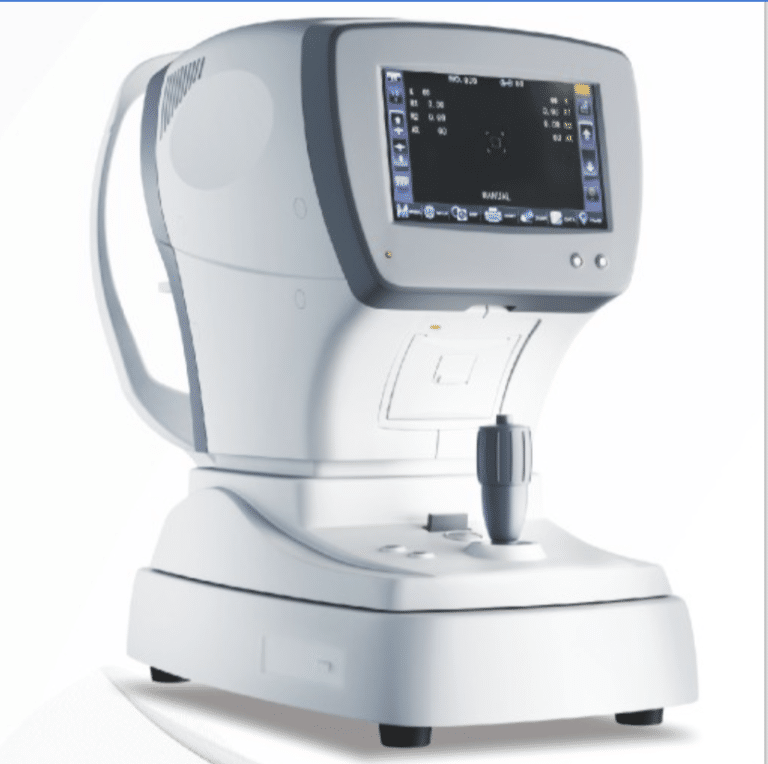
18 October 2026 · 3 min read
Auto keratometer: what it measures and how to choose one
Auto keratometer explained: what a keratometer measures, how to read K1, K2 and KRT on the printout, and what to look for in an autorefractor-keratometer.

18 October 2026 · 3 min read
Slit lamp price in 2026: what a slit lamp costs
Slit lamp price in 2026: what a new slit lamp costs by magnification steps, what a digital slit lamp with camera adds, and what else to…

7 September 2024 · 12 min read
The Future of Eye Care: Tele-Optometry and Remote Care
This comprehensive article explores the rise of tele-optometry, The article also delves into the technology behind tele-optometry,