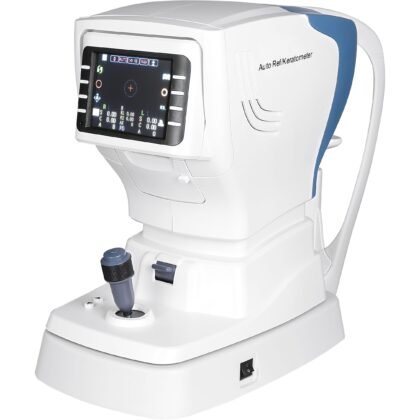
Measuring range
- Sphere: −20 to +20 D (VD = 12 mm), 0.125 D steps
- Cylinder: −8 to +8 D, 0.125 D steps
- Axis: 0–180°, 1° steps
- PD: 45–88 mm, 1 mm steps
- Vertex distance (VD): 0, 12 and 13.75 mm
- Smallest measurable pupil: Ø 2.0 mm
Keratometry
- Radius of curvature: 5.0–10 mm (0.01 mm steps)
- Corneal power: 33.75–67.5 D (at refractive index 1.337), 0.12 or 0.25 D steps
- Corneal astigmatism: 0.0–8.00 D, 0.12 or 0.25 D steps
- Axis: 1–180° (1° steps)
- Corneal diameter: 2.0–14.0 mm (0.1 mm steps)
- Memory: 10 readings for each eye
Other
- Colour fogging chart
- Screen: 7-inch TFT LCD
- Thermal printer
- Power supply: 220 V ±10%, 50 Hz, 60 VA
- Size: 478 × 268 × 472 mm
- Weight: about 20 kg
What does a keratometer measure, and how do you read K1 and K2? Read our guide: Auto keratometer: what it measures and how to choose one.