Refractometer
- Vertex distance (VD): 0.0 / 12.0 / 13.75 / 15 mm
- Sphere: −20.00 to +20.00 D (at VD = 12 mm)
- Cylinder: 0.00 to ±10.00 D (0.12 / 0.25 D steps)
- Axis: 1–180° (1° steps)
- Cylinder notation: −, +, mixed
- PD: 30–80 mm
- Smallest measurable pupil: Ø 2.0 mm
Keratometry
- Radius of curvature: 5.0–10 mm (0.01 mm steps)
- Corneal power: 33.00–67.50 D (at refractive index 1.337), 0.05 / 0.12 / 0.25 D steps
- Corneal astigmatism: 0.0 to −15.00 D (0.12 or 0.25 D steps)
- Axis: 1–180° (1° steps)
- Corneal diameter: 2.0–12.0 mm (0.1 mm steps)
Other
- Memory: 10 readings for each eye
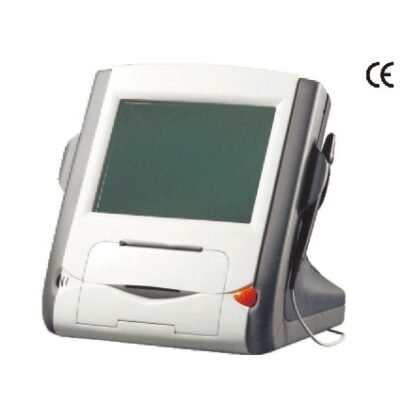
- Built-in thermal printer
- Screen: 5.7-inch colour TFT LCD
- Auto tracking: 16 mm (up and down)
- Energy saving: screen saver after 5 or 15 minutes
- Power supply: AC 100–240 V, 50/60 Hz, about 100 VA
- Size: 484 (L) × 270 (W) × 450 (H) mm
- Weight: about 17 kg
What does a keratometer measure, and how do you read K1 and K2? Read our guide: Auto keratometer: what it measures and how to choose one.